
01 Component repairs
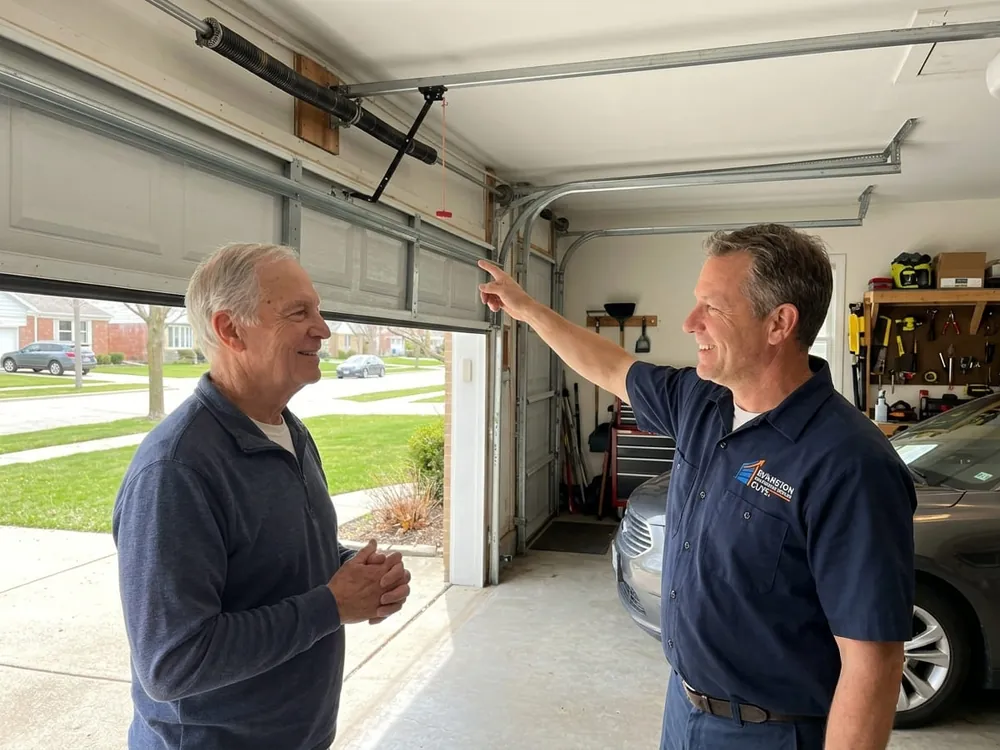
Noisy garage door repair in Evanston, IL
Every noise a garage door makes means something, and some of them mean stop. This page tells you which is which before you spend anything.
- Diagnosis by sound and by where it happens in the travel
- Nylon rollers, hinges, struts and bearings on the van
- Opener rail bracing for rooms above an attached garage
- Owner-operated in Evanston since 2011
02 Sound diagnosis
What the noise is telling you
Work out which row you are in before anyone sells you anything. Run the door through one full cycle and note where in the travel the noise happens, as well as what it sounds like.
| Noise | Likely cause | Urgency | Typical fix |
|---|---|---|---|
| Grinding or rumbling, steady, all the way through | Dry or collapsed steel roller bearings, dry hinges | Low — but it is eating your track | Nylon roller set, hinge service, correct lubricant |
| Squealing or chirping, worse on cold mornings | Dry hinge pivots, dry roller stems, a dry torsion spring | Low | Clean and lubricate hinges, stems and spring coils |
| Rattling as it runs | Loose hinge screws, loose track brackets, a loose opener rail | Low to medium — it loosens further | Tighten and re-lag hardware, reset track spacing |
| Banging or popping near the top of travel | Sections flexing under the opener pull, no strut on the top section, worn top fixtures | Medium | Fit a strut, replace top fixtures and rollers |
| One loud bang, then the door will not lift | Torsion spring failure | High — stop using it | Matched-pair spring replacement |
| Scraping, metal on metal, in one spot | A roller riding the track flange, spread or bent track, a door out of level | Medium to high | Track alignment, cable and levelling check |
| Repeating click near one hinge | A cracked hinge, or a roller stem worn oval | Medium | Replace that hinge and roller |
| Opener hums, nothing moves | Stripped drive gear, seized trolley, or a door gone heavy because a spring has failed | High — stop using it | Balance the door first, then gear or trolley work |
| Vibration felt through the ceiling of the room above | Structure-borne noise: rail lagged straight to joists, chain drive, unbalanced door | Low for the door, high for the household | Isolate and brace the rail, nylon rollers, belt or wall-mount opener |
Noise not listed? Ring (224) 505-2236 and make the sound down the phone. People are embarrassed to do it. It works.
03 Cosmetic or warning
Which noises are annoying, and which are the door asking for help
One rule sorts most of it. A noise that has sounded the same for three years is a maintenance job. A noise that turned up last week is a diagnosis.
Steady, unchanging, all-the-way-through noise is nearly always wear: dry bearings, dry hinges, hardware never touched since the door went on. Unpleasant, slowly chewing the track, not going to drop anything on your car. Fix it when convenient.
The noises that matter share a shape. They are new, they happen at one point in the travel, or they arrive with a change in how the door behaves — slower, heavier, hesitating, closing crooked.
The bang at the top of travel
This one gets dismissed constantly. As the door reaches the top, the opener pulls on the top section while the rest of the door turns the curve. If that section has no strut across it, it flexes, and when it snaps back you get a bang. Left alone, the flexing works the top fixtures loose and eventually cracks the section around the screw holes. A strut is a length of steel bolted across the section. Twenty minutes, and a fraction of a replacement panel.
The single sharp bang
Different animal. One crack like a rifle shot, often overnight, then the door feels like it weighs a ton. That is a torsion spring. Stop using the opener and read why springs break — running an opener against a broken spring strips a gear and bends the top section in the same week.
Scraping in one spot
A roller climbing the track flange, usually because the track has spread, the door is running out of level, or a cable has stretched on one side. It is the noise immediately before a door comes off its track. Do not ignore it and do not grease it.

04 Best value fix
Nylon rollers: the single biggest improvement on most doors
Most doors we meet here are running on the rollers they were built with: pressed steel wheels on unsealed bearings, or plain steel wheels on a bare stem. Once the grease has dried out — and on a door installed in 1994 it has — they stop rolling and start skidding. That is the rumble.
Sealed nylon rollers run on ball bearings inside a nylon tyre. They roll instead of skidding, they do not transmit metal-on-metal noise into the track, and they do not rust — which matters in an unheated detached garage collecting road salt off your tyres all winter. Evanston spreads thousands of tons of granular salt and tens of thousands of gallons of brine across 190 miles of road in a season, and a share of it ends up on your garage floor.
Stem length has to match the door — a long stem on a short-stem door is a fast route to a leaning door. Fitted properly, a set of ten is the cheapest meaningful thing you can do to a noisy door, and it is where we start on almost every roller job.
- Sealed ball bearings instead of dry pressed steel
- No metal-on-metal transmission into the track
- Will not seize or rust in a salty unheated garage
- Fitted one at a time, door supported, never all at once
05 In order of effect
What actually makes a garage door quieter
Ranked by how much difference each makes. Most doors need the first three and nothing else.
- A full set of sealed nylon rollers, stem length matched to the door
- Every hinge screw, track bracket and lag re-tightened, and anything cracked replaced
- The right lubricant on hinge pivots, roller stems, bearings and spring coils
- A strut across any section that visibly flexes, starting with the top one
- Track spacing and plumb corrected so the rollers stop loading sideways
- The door balanced properly, so the opener stops fighting it — a heavy door is a loud door
- The opener rail braced back to structure and isolated, not screwed through drywall
- A belt drive or a wall-mount jackshaft unit where the ceiling rail is the problem
We set force and travel limits to the published DASMA opener guidance and test both photo-eyes before we leave. A quieter door that no longer reverses on an obstruction is not an improvement.
06 Lubrication
The right lubricant, the right places, and the two you must not use
Half the noisy doors we are called to have already been sprayed with something. Usually the wrong thing, in the wrong place.
What to use
A garage-door lubricant — a lithium-based or silicone spray sold for the job. It stays put, does not run, and does not attract grit the way heavy grease does.
Where it goes
- Hinge pivot points, where the pin turns in the barrel
- Roller stems where they enter the hinge — not the nylon wheel itself
- The torsion spring coils, a light pass end to end
- End bearing plates and the centre bearing
- The lock bar and any side latch
- A light coat on a chain drive. Belts get nothing at all
NEVER
Never grease the track. The track is a running surface for wheels, not a bearing. Grease turns it into flypaper for grit and concrete dust, and that mixture laps the rollers flat. It also makes rollers skid rather than turn — the opposite of what you want. Wipe the track clean and leave it dry.
Never use WD-40 as a lubricant. It is a water-displacing solvent. It cleans, it frees a rusted lock, then it evaporates and leaves the joint drier than before you started. Use it to free something seized, then wipe it off and apply an actual lubricant.
How often
Twice a year is plenty. Late autumn, before the 121 days a year with a low at or below freezing start stiffening everything up, and again in spring once the salt season is over and you can wash the track down. Ten minutes each time. It will not fix a collapsed bearing, but it stops a good one becoming one — it is on the list in our homeowner safety check.
07 The visit
How we chase a noise down
Noise diagnosis is mostly listening, done in a particular order.
Cycle it on the opener, then by hand
First with the opener, to hear the noise as you hear it. Then disconnected, by hand, through the full travel. Anything that survives with the motor off is the door, not the opener.
Balance test
Door lifted to waist height and released. A balanced door stays put. One that sinks or shoots up is fighting the opener all day, and that shows up as noise long before it shows up as failure.
Hardware, top to bottom
Every hinge, roller, bearing, bracket, strut and lag checked and tightened. Cracked hinges and oval roller stems get replaced there and then.
Opener, rail and structure
Rail mounting checked back to solid framing, force and limits reset, photo-eyes tested. Then we run it while you stand in the room above and tell us what you can still hear.
If the honest answer is that a forty-year-old chain drive screwed to the joists will never be quiet under a bedroom, we say so rather than sell three visits that do not fix it.
08 The bedroom above
When the garage is attached and someone sleeps over it
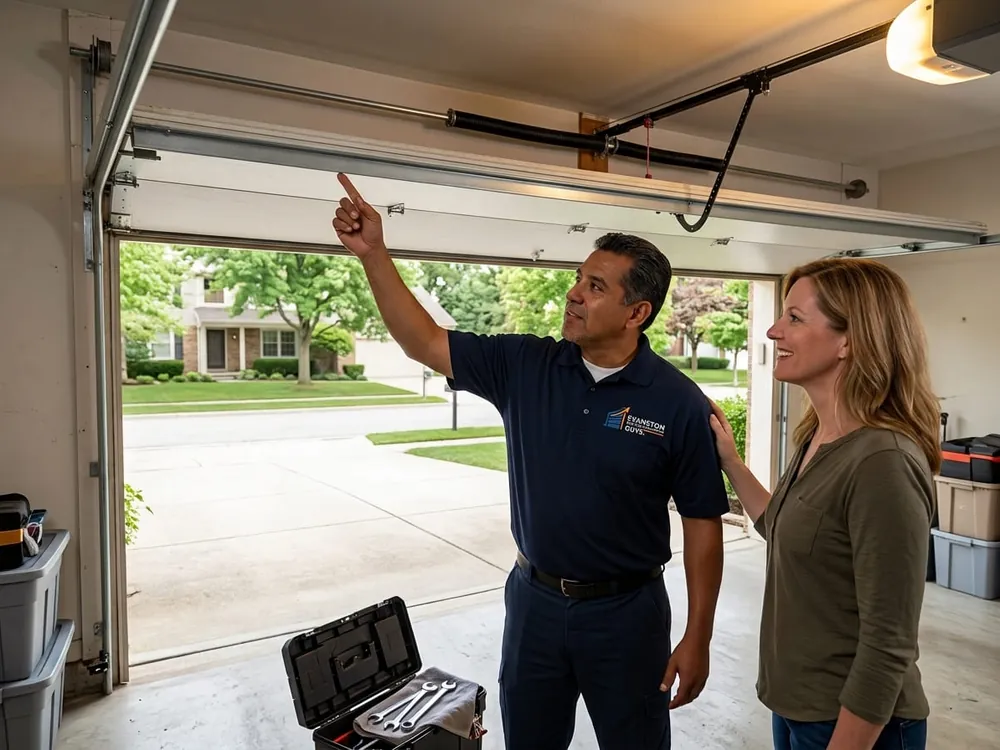
A specific Evanston and near-suburb problem. The post-war blocks on the west side — the 1950s stock out toward Hartrey and McCormick, and the split-levels all over Skokie — put an attached garage under a bedroom. The door may be no louder than anyone else’s. It just has an audience at six in the morning.
What carries upstairs is mostly not airborne noise through the ceiling. It is structure-borne: vibration travelling up the opener rail into the joists and radiating off the ceiling plane like a drum skin. Which is why people who buy a “quiet” opener and bolt the rail to the same joists are disappointed.
What works, in order: hang the rail from solid blocking with isolation pads rather than lagging it flat to a joist; never fix it into drywall or a ceiling grid; use a belt drive; and where the ceiling is the problem, take the motor off it entirely with a wall-mount jackshaft opener beside the torsion shaft. Add nylon rollers and a balanced door and the change is dramatic. If the door is a bare uninsulated pan, insulation cuts the airborne share too and does something for the room above — the Department of Energy makes the general case. Which opener suits an older garage is a longer story, and it is in the buying guide for old garages.
- Rail braced to structure and isolated, never into drywall
- Belt drive, or a wall-mount unit off the ceiling entirely
- Nylon rollers and a properly balanced door
- Soft-start and soft-stop travel set, not force turned up
06 Questions we get asked
Noisy garage door questions from Evanston homeowners
What people ask once they have decided the noise has gone on long enough.
Is a noisy garage door dangerous?
Can I just spray it myself?
Why should I never put grease on the track?
Will new rollers really make that much difference?
My opener hums but the door does not move. What is that?
The noise only happens in winter. Why?
Can you make a garage door quiet enough to open under a sleeping child?
Garage door stuck, loud, or off its tracks?
One call reaches the people who will actually be doing the work. Tell us what the door is doing and we will tell you straight what it needs — and when we can get a truck to you.