
Chain drive
A metal chain pulls the trolley along a rail. Cheapest, toughest, and genuinely fine on a detached garage nobody lives above. Loud — which over an alley is nobody's problem.
01 Repair & installation
Half the garages in this city have almost no headroom and nothing overhead worth hanging a rail from. That is why we fit more wall-mount openers than anyone expects, and why the survey comes before the recommendation.
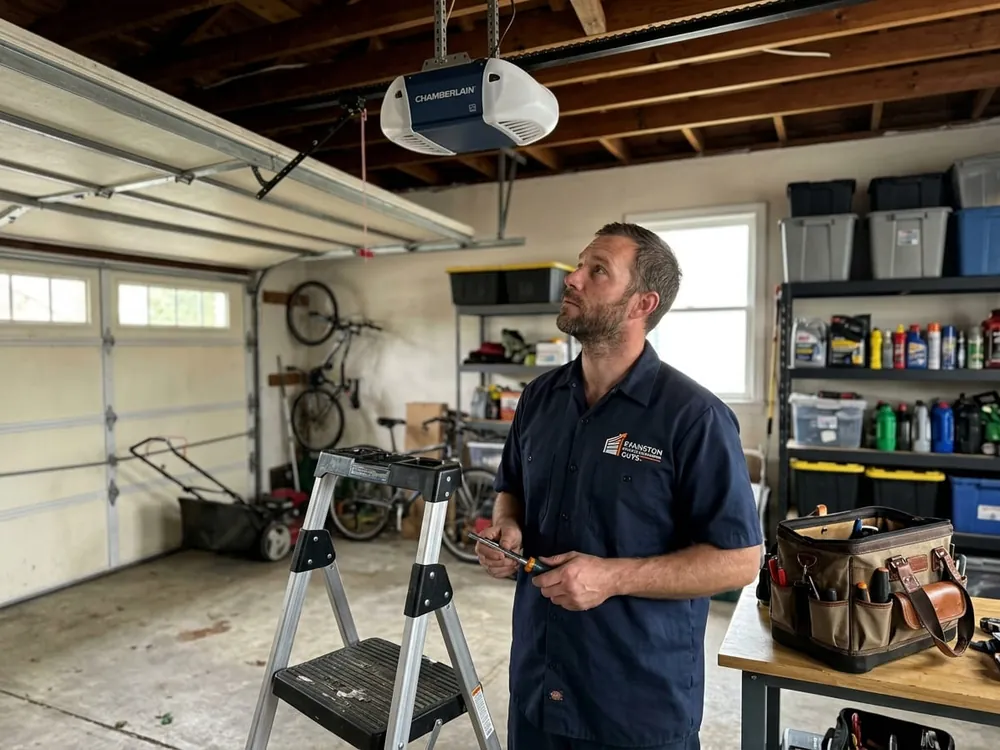
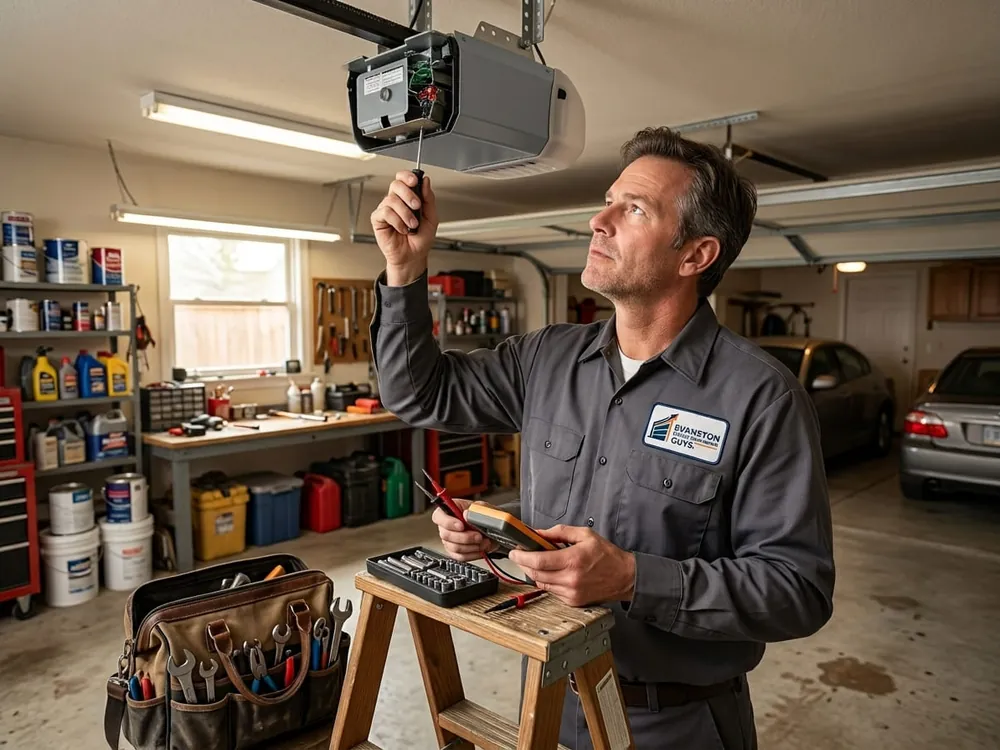
02 Start here
A conventional opener needs two things an old Evanston detached garage often does not have: about seven inches of clear ceiling above the door's travel for the rail, and something structural up there to hang it from.
Walk into a 1920s alley garage and look up. The rafters sit low, they are usually undersized by modern standards, and there is frequently nothing between them but daylight and a century of dust. Hanging a motor head and a ten-foot rail off that is at best awkward and at worst a slow-motion failure — the hangers work loose, the rail sags, the trolley binds, and eventually a gear strips.
A wall-mount jackshaft unit does away with all of it. The motor bolts to the wall beside the opening and drives the torsion shaft directly, so the door is turned rather than pushed. The ceiling stays empty. Headroom stops being the constraint. And the whole assembly sits at chest height where it can actually be serviced without a ladder over your car.
It is not the answer everywhere — it needs a torsion spring system and clear side room, and it costs more than a chain drive. But on this housing stock, where roughly four in ten homes predate 1940 and the garages behind them were built to the same vintage, it solves the actual problem instead of working around it.
03 The other case
The second half of our opener installation work is the opposite building: a newer attached garage with a bedroom, a home office or an ADU over the top. Here the constraint is not headroom. It is noise transmitted into a room where somebody is trying to sleep at 6:40 in the morning.
Three things make a garage loud overhead, and only one of them is the opener.
If you are fitting an ADU over a garage — Evanston has permitted accessory dwelling units since 2020, including above-garage units — get the opener and the door specified together. An insulated door on a belt or wall-mount unit is a different building to live above than a single-skin door on a chain.
04 The options
Drive type first, then the extras. We do not fit features you will not use, and we will say when one is not worth the money.
A metal chain pulls the trolley along a rail. Cheapest, toughest, and genuinely fine on a detached garage nobody lives above. Loud — which over an alley is nobody's problem.
A reinforced rubber belt instead of a chain. Markedly quieter and smoother, with less to rattle loose. The default choice for an attached garage, and worth the difference if there is a room above.
Mounts beside the door and turns the torsion shaft. No rail, no ceiling hangers, no headroom requirement. The answer for low-headroom detached garages, and the quietest of the three.
Worth having, and not just for storms. A power cut with the car inside and a wall-mount or belt unit means no ladder work and no wrestling with a release cord in the dark. It also keeps the photo-eyes live.
The genuinely useful part is not opening the door from your phone. It is being told the door has been open for forty minutes and closing it from the office. Everything else is convenience.
An exterior keypad is the most-used accessory we fit, especially on alley garages where you arrive on foot from the street. We program it, show you how to change the code, and clear old remotes from the receiver.
05 Matching the unit
A recommendation is only as good as the building. This is the shorthand we use on site, before anything gets specified.
| Your garage | What usually suits it | Why |
|---|---|---|
| Pre-war detached, low headroom, open rafters | Wall-mount jackshaft | No rail to hang, no headroom needed, serviceable from the ground |
| Pre-war detached with extension springs | Convert to torsion, then wall-mount or belt | A jackshaft drives a torsion shaft — there has to be one |
| Detached with decent headroom, nobody above | Chain drive | Cheapest and most durable; noise is not a factor over an alley |
| Attached garage, bedroom or ADU above | Belt drive, or wall-mount | Quiet matters more than anything else here |
| Heavy insulated double door | Higher-rated DC unit, belt or wall-mount | Weight and inertia, not just width, decide the rating |
| Garage used six or more times a day | Higher duty rating and a high-cycle spring to match | Duty cycle is what actually wears an opener out |
| Condo or parking-deck door | Commercial operator, never residential | See the note below — this is the most expensive mismatch we see |
If you are not sure which of these describes your garage, call (224) 505-2236 and describe what you can see above the door. Two questions usually settles it.
06 Before we specify
An opener is bolted to a building and connected to a door. Both have a vote.
If the door does not balance, we fix that first. Fitting a new opener to a door with tired springs is the most reliable way to strip a brand-new gear inside a year, and we will not do it.
07 Install day
Most installations are two to three hours. A wall-mount on a garage that needs a torsion conversion first is longer.
Hand balance checked with the old opener disconnected, rollers and hinges looked over, spring condition confirmed. Anything wrong here gets sorted before the new unit goes anywhere near it.
Motor head, rail, hangers and brackets removed, low-voltage runs traced, and the old opener taken away with us. Ceiling brackets get removed rather than left dangling.
Wall-mount bolted to solid framing beside the opening and coupled to the torsion shaft; overhead units hung on isolated hardware into real structure, never into drywall or a furring strip.
Travel limits and force set to the door as it behaves, photo-eyes aligned and tested against an obstruction, mechanical reversal tested, remotes and keypad programmed, and you operate it yourself before we leave.
We set force to the minimum that moves the door reliably, in line with DASMA's opener guidance. Force is never turned up to mask a bind — that removes the protection instead of the problem.
08 Sizing and duty
Two numbers decide whether an opener lasts a decade or two winters, and neither is printed on the box in a way most people notice.
Openers get sold on horsepower-equivalent ratings, and people pick by door width. Width is the wrong proxy. An insulated double door can weigh half as much again as a single-skin double of the same size, and that mass has to be started and stopped several thousand times a year. Fit a unit at the bottom of its rating to a heavy door and it will run hot, wear its gear early and strip it on the first cold morning where the bottom seal is frozen down. We weigh the door and specify from that.
The same logic that governs spring cycle ratings governs openers. A residential unit is designed around a household opening the door a handful of times a day. Push it well past that and its service life collapses.
THE MISMATCH WE SEE MOST
A residential opener fitted to a shared condo or parking-deck door that cycles sixty or more times a day. It is not a bad unit; it is doing roughly ten times the work it was designed for. Those units routinely fail inside a year, usually in the middle of a weekday, with residents' cars on the wrong side of the door. That job needs a commercial operator with a duty rating to match, and it is cheaper over three years even before you count the failed unit.
A wall-mount on a garage with no side room, because it will not fit and we would rather say that at the survey. A top-of-the-range smart unit on a detached garage with no Wi-Fi that reaches. And a new opener entirely, when the existing one needs a gear kit or a capacitor — repair is usually the cheaper answer and we repair far more than we replace.
If the door is going at the same time, spec them together: a new door changes the weight the opener has to move, and getting both right at once costs less than getting them right one at a time. We install across Evanston and the near suburbs from Brown Ave — west Evanston, southeast Evanston, Skokie, Morton Grove and Wilmette. Every install ends with the reversal test, following the published system safety guidance, and there is more background in our buying guide for old garages and the story of the shop.
06 Questions we get asked
The questions that come up at almost every survey.
One call reaches the people who will actually be doing the work. Tell us what the door is doing and we will tell you straight what it needs — and when we can get a truck to you.