
01 Evanston neighborhood
Garage door repair in Downtown Evanston
Downtown is the one part of Evanston that is not a detached-garage market, and we are not going to pretend otherwise. The doors here sit on parking decks, ramp heads, underground condo garages and alley loading bays, and they are specified, serviced and billed differently from a house door.
- Condo boards, property managers and building engineers, not homeowners
- Parking-deck sectionals, jackshaft operators and gate arms
- High-cycle spring specification for doors that run all day
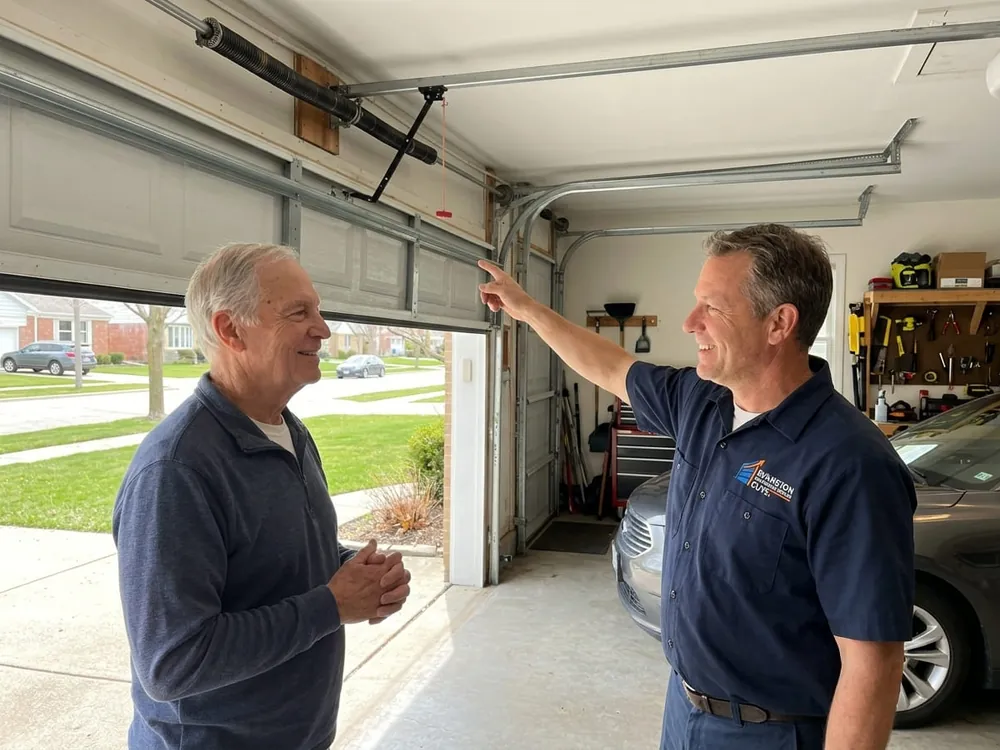
- Chris Duvall came from ten years of commercial overhead doors
02 The neighborhood
The part of Evanston with almost no alley garages
Downtown Evanston runs roughly from Emerson Street south to Lake Street, and from Ridge Avenue east to Chicago Avenue and Sheridan Road, with Fountain Square at Sherman, Orrington and Davis as its centre. It is Ward 1, it holds the Davis Street Metra stop and the Davis CTA Purple Line station, and it butts directly onto the western edge of Northwestern's campus.
Every other page on this site talks about detached garages off alleys. Downtown does not have them, in any quantity worth writing a paragraph about. Roughly half the housing units here are apartments. The rest is high-rise and mid-rise condo, converted 1920s commercial stock, Art Deco frontage along the older blocks, and a scatter of Tudor Revival at the edges where downtown fades into the residential grid. Parking is structured, decked or underground.
So the honest description of our downtown work is this: it is commercial and multi-family door work that happens to be inside a residential postcode. If you own a condo in a tower off Orrington, you do not have a garage door. Your building has one, and the person who calls us about it is a property manager, a board member or a building engineer.
What that changes technically
Cycle count, mostly. A single-family door in South Evanston might run three or four cycles a day. The ramp door on a sixty-unit building downtown can do that before nine in the morning, and it will do it in January with road salt dripping off every car that passes underneath it. Springs on those doors are specified by cycle rating rather than by size alone, and the difference between the right spec and the cheap spec shows up two winters later as a mid-week failure that traps forty residents' cars.
Operators change too. A ramp-head door with a tight ceiling gets a jackshaft unit mounted on the wall beside the torsion shaft, not a trolley rail down the middle of a drive aisle. Add safety loops, photo-eyes on both jambs, fire-alarm interface where the building requires it, and a keypad or fob reader that has to talk to whatever access system the building already runs. That is a different conversation from swapping a spring on a bungalow.
Historic buildings, modern doors
A good number of downtown's service openings are original masonry punched into 1920s commercial buildings. The opening is not square, the header is not what a modern track chart assumes, and the last installer solved that with shims. We would rather correct it. If your building is individually landmarked — Evanston has over 430 local landmarks outside any district — exterior work visible from the street or the alley can need review, so check with Historic Preservation first. The City of Evanston site or a call to 311 will tell you your parcel's status in one go.
03 By building type
What the door actually is, and what goes first
Five building types cover nearly all of our downtown calls. Find yours, and you will already know roughly what we are going to be looking at.
| Building type | The door you have | What usually fails first |
|---|---|---|
| Mid-rise condo, underground garage | One insulated sectional at the ramp head, jackshaft operator | Springs and cables — driven by cycle count, not age |
| Structured parking deck | A wide sectional or rolling grille at the entry, plus a gate arm | Operator limits, safety loops and photo-eye alignment |
| Converted 1920s commercial building | A modern sectional retrofitted into an original masonry opening | Track that was shimmed instead of corrected; header and jamb condition |
| Restaurant or retail loading bay off the alley | A small rolling steel door or a light sectional | Bottom bar, weatherseal, and rust from road salt and standing water |
| Art Deco and mixed-use frontage | Rolling steel security shutters over glazing | Curtain slats, side guides and the hood bearing |
Rolling steel and sectional hardware runs on a cycles-per-day service interval rather than an annual one. Details on our commercial garage doors page.
04 What we get called for
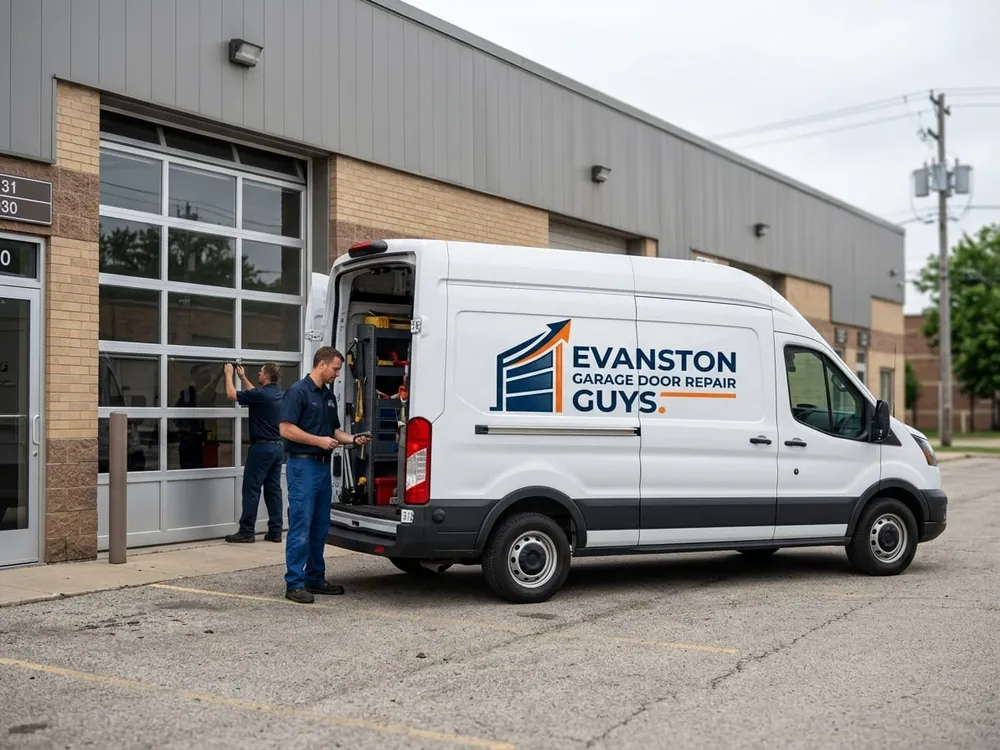
The downtown job list
Nothing on this list is a residential job. That is the point of the page.
- Parking-deck and ramp sectionals — service, repair and full replacement, including doors that have to keep working while the deck stays open
- High-cycle spring replacement — sized to the door's real weight and its real duty, not to whatever was on it before
- Jackshaft and gate operator faults — limits, encoders, safety loops, reversing edges and photo-eyes on both jambs
- Doors stuck open or stuck shut — a deck door frozen open is a security problem the same night, and we treat it that way
- Track and header correction in retrofitted 1920s masonry openings, where the last fix was a stack of shims
- Section and slat replacement after a delivery truck or a distracted driver finds the opening at an angle
05 How it works
What happens when a board or a manager calls us
Multi-family work has an approval chain. We write for that chain rather than pretending it does not exist.
Tell us the building, not the door
Address, how many openings, whether it is a ramp head or a street-level deck entry, and who can get us fob or key access after hours. Half of downtown's wasted trips are access problems, not door problems.
We look before we quote
We measure the opening, weigh the door where it matters, count the daily cycles and check the operator and the safety devices. On a shared deck we also work out how to keep the entry usable while we are in it.
You get the cheaper option too
If new springs and a set of rollers will buy the door another five winters, we say so, even where a replacement door is the larger invoice. If the door is genuinely past it, you get that straight as well.
The scope goes out in writing
Boards meet monthly and managers answer to owners. You get a written scope you can circulate, with the service call charge disclosed up front and applied against the work if you go ahead.
We do not subcontract. The people who quote the job are the people who turn up to do it.
06 Services downtown
What we cover between Emerson and Lake
The residential list still exists — plenty of downtown owners also have a garage at a second property, and the blocks just west of Ridge shade quickly into ordinary Evanston housing.
- Commercial and multi-family door service across decks, ramps and loading bays
- General overhead door repair on sectional, rolling steel and grille doors
- Jackshaft operator installation where a trolley rail will not fit a drive aisle
- Cable, drum and shaft work on wide multi-spring assemblies
- Roller and hinge replacement on doors running hundreds of cycles a week
- New door installation into original masonry openings
- Out-of-hours failures where a building is left open or a deck is sealed shut
- Auto-reverse and photo-eye testing on every visit, on every door we touch
Neighbouring pages: Northeast Evanston north of Emerson, Southeast Evanston south of Lake, and West Evanston out past Ridge.
06 Questions we get asked
Downtown Evanston garage door questions
Do you do work for condo associations and property managers?
Our ramp door fails every couple of years. Is that normal?
The deck door is stuck open. How fast can you get there?
Our building is from the 1920s. Does the door need City review?
Can you service a gate arm and a barrier as well as the door?
I live in a downtown condo but own a house elsewhere in Evanston. Do you cover both?
Garage door stuck, loud, or off its tracks?
One call reaches the people who will actually be doing the work. Tell us what the door is doing and we will tell you straight what it needs — and when we can get a truck to you.