
01 Repair & installation
Broken garage door spring repair in Evanston, IL
A spring is the only part of your garage door holding two hundred-odd pounds in the air, and it is the one part certain to fail eventually. We replace them properly — matched pairs, sized to the door's measured weight, with the safety hardware the door was supposed to have.
- Torsion and extension springs, sized to the door not to a catalog
- Always replaced in matched pairs, never one side only
- Springs, cones, cables, drums and bearings carried on the van
- Balance and auto-reverse tested before we pack up
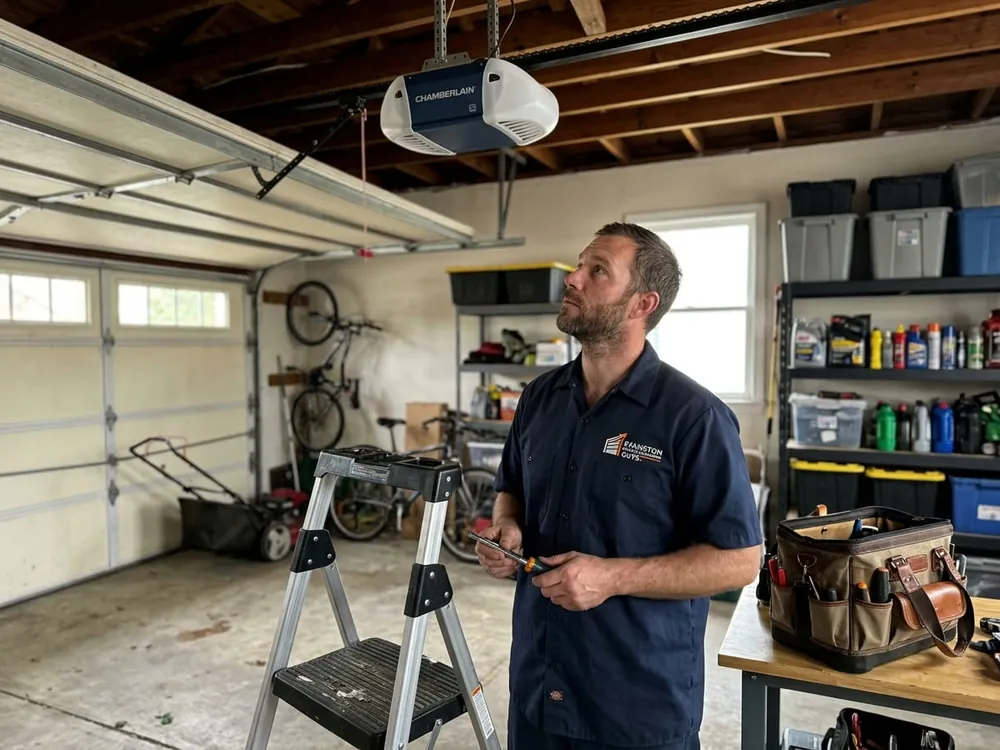
02 What actually happened
The bang you heard was the spring, and the opener is fine
Most people who need broken garage door spring repair in Evanston call us to say the opener has died. It usually has not. Something went off like a rifle shot in the garage overnight, and in the morning the motor runs, the chain moves, and the door sits there.
Here is the arrangement. Your door weighs somewhere between about 130 pounds for a single steel panel on an old alley garage and 400 pounds for an insulated double. The opener cannot lift that and was never built to. The springs do. They store energy as the door comes down and give it back on the way up, so a balanced door rises with one hand. The opener is a positioning motor.
Take the spring out of that equation and the opener is being asked to deadlift a refrigerator. It stalls, strips its drive gear, or lifts the door six inches and gives up. All three look like an opener fault. None are.
How to check before you call
Stand inside the garage, pull the release cord to disconnect the opener, and look up. On most doors you will see a steel shaft running horizontally above the opening with one or two springs coiled around it. On older single-car garages you may instead see a long spring stretched along each horizontal track. Either way, look for a clean gap of an inch or two in the coil. That gap is the whole diagnosis.
Then try lifting it by hand. A healthy door comes up smoothly and stays where you leave it. One with a broken spring feels bolted to the floor. Do not force it, and do not put the opener back on to try again — that is how a bent top section gets added to the bill. Leave it down and call (224) 505-2236.

03 Cycles, not years
Springs are rated in openings, and nobody tells you that at the point of sale
A garage door spring has no expiry date. It has a cycle rating — one cycle being one full open and one full close — and the standard spring hung on most doors in this country is rated at 10,000 cycles.
Do the arithmetic on your own household. Two adults leaving and coming back is four cycles a day; add a school run and a trip to the Home Depot on Hartrey and you are at six. At four a day a 10,000-cycle spring is doing well to see seven years. At six or seven — a household using the garage as the front door, which is most of Evanston in February — you are looking at four or five.
That is not a defect. It is a consumable part reaching the end of a published rating, the same way tyres do — and it means you get to choose. Higher-cycle wire costs more up front and typically doubles the rated life, which on a hard-worked door is the cheaper decision over ten years. We will tell you which side of that line yours sits on.
- One cycle = one open plus one close
- 10,000 cycles is the common default, not a legal minimum
- Four openings a day burns roughly 1,460 cycles a year
- Higher-cycle wire uses thicker steel and a longer coil for the same lift
04 Two systems
Torsion springs and extension springs are not interchangeable
Which one you have is mostly an accident of when the garage was built and who last touched it. Roughly four in ten Evanston homes predate 1940, so extension springs on narrow single-car alley garages are far more common here than they would be in a newer suburb. Both systems work. They fail differently, and they need different safety hardware.
| Comparison point | Torsion springs | Extension springs |
|---|---|---|
| Where they sit | Coiled on a steel shaft above the opening | Stretched along the horizontal track, one each side |
| Typically found on | Most doors fitted since the 1970s, and nearly all doubles | Older single-car garages — very common on pre-war Evanston alley garages |
| How failure looks | A single sharp bang, then a clean gap in the coil | A sagging, stretched spring, or a spring that lets go and whips |
| Containment | The shaft runs through the coil, so a failed spring stays put | Needs a safety containment cable through the spring — often missing |
| Headroom needed | Roughly 12 inches above the opening for a standard kit | Works with almost none, which is exactly why old garages have them |
| Balance behaviour | Better side-to-side control, less racking | One side ages faster and the door starts lifting crooked |
| Replacement rule | Matched pair on a two-spring door, every time | Both sides together, every time |
If your springs run along the tracks and there is no cable threaded down the middle of them, that is the first thing we will want to fix. It costs very little and it is the difference between a spring failing and a spring flying.
05 The safety part
Why we will not sell you a spring over the counter
We get asked. The answer is no, and it is not a sales tactic. A wound torsion spring holds a few hundred pounds of stored energy in a coil the length of your forearm, and it releases all of it through whatever is holding the winding bar. The Consumer Product Safety Commission has published on garage door hazards for decades and the injury pattern has not changed: hands, faces, and the ladder you were standing on.
- Winding bars must be the right diameter and length for the cone — a screwdriver is not a winding bar, and that is how most people get hurt
- The spring must be sized to the door's measured weight, not to what the last installer had on the shelf
- Set screws bite into the shaft — reusing a cone on a chewed shaft is how a spring unwinds three weeks later
- Lift cables have to seat in both drums at equal tension or the door climbs one side first
- End bearing plates and the centre bearing take the load — a seized bearing eats a new spring early
- Extension springs need a containment cable, and an unrestrained extension spring is a genuine projectile
- Balance has to be re-tested by hand with the opener disconnected before the opener goes back on
- Opener force and travel limits then get reset to the new balance, not left compensating for a dying spring
We follow the published DASMA guidance on residential garage doors on spring sizing and testing. If you want the longer version of how springs work and why they give up, we wrote a full explainer on spring failure.
06 Why January is our busiest month
The numbers behind the first-hard-freeze phone call
days a year with a low at or below freezing, on the NOAA 1991–2020 normals for this area
January average high — against an average low of 18.8°F, so the daily swing straddles freezing all midwinter
cycles on a standard spring — roughly seven years at four openings a day, four at seven
tons of granular road salt Evanston spread in one recent winter, plus 52,616 gallons of brine
Sources: NOAA climate normals and the City of Evanston. Steel loses ductility as it cools, so a spring already sitting at 9,600 cycles picks the coldest morning of the year to finish.
07 The visit
How a spring replacement actually runs
Forty-five minutes to a couple of hours on most doors, depending on what else the failure took with it.
We weigh the door
Opener disconnected, door lifted against a known reference. A door nobody has weighed is a door nobody has sized a spring for, and half the early failures we see are wrong-weight springs from a previous job.
The old spring comes off safely
Proper winding bars, controlled unwinding of the surviving spring, cables released from the drums, shaft checked for scoring where old set screws bit in.
A matched pair goes on
Both replaced together even if only one broke, sized to the measured weight, wound to a calculated count rather than by feel, cables reseated at equal tension.
Balance, then safety
Door hand-tested at knee, waist and head height — it should stay where you leave it. Then force and travel limits reset, and both photo-eyes tested against an obstruction while you watch.
If a cable snapped when the spring went, or a drum is chewed, we will show you the part before we replace it. Cable repair often rides along with a spring job.
08 Local conditions
What shortens spring life on this side of the North Shore
Three things about Evanston garages take cycles off a spring that a spec sheet does not account for.
Road salt in an unheated detached garage
Not lake salt. Lake Michigan is fresh water, and anyone selling you coastal corrosion here is reading from a template written for somewhere else. The real problem is the 3,377 tons of granular salt and 52,616 gallons of brine the City spreads across 190 miles of road in a winter, all of which comes home in your wheel arches and drips onto a slab that is the same temperature as the alley. Surface rust raises friction inside the coil, the coil works harder per cycle, and the rated life quietly shrinks. On a heated attached garage this barely matters. On a 1920s detached garage it matters a lot — see what salt does to door hardware over a winter.
Doors that were never balanced properly in the first place
A spring undersized by twenty pounds of lift does not announce itself. The door works. It is just heavy, so every cycle stresses the wire harder than the rating assumed. We find this constantly where someone added insulation panels, or swapped a single-skin steel door for a heavier insulated one and reused the original springs. If your door was replaced but the springs were not, that is worth a look.
Slabs that have moved
The City grades more than 300 unpaved alleys each spring to deal with ruts and standing water, which tells you what those approaches do to a slab over eighty years. Settle one corner and the track goes out of plumb, the door binds, and the springs carry a fight they were not designed for. Fix the spring without fixing the bind and you will see us again next winter. If the door already sounds wrong going up, the noise is telling you something, and one that has jumped a track needs the track sorted first.
When the spring is not the last word
Sometimes a spring failure is the moment to stop spending. If the door is a rotted-bottom wood original, if the framing will not hold new hardware, or if springs, cables and rollers are all going at once, we will lay out what a replacement costs against another repair and let you pick. Half the time the repair is still the right answer, and we will say so.
We work a tight radius from the shop on Brown Ave, so west Evanston, south Evanston and southeast Evanston are a short run and Skokie and Wilmette are not much further. If the car is stuck behind the door, say so when you call. If it cannot wait, see emergency repair — or read who you are actually getting.
06 Questions we get asked
Spring questions from Evanston homeowners
The ones we answer on the phone two or three times a week in January.
Only one spring broke. Do I really have to replace both?
My opener runs but the door will not move. Is that the opener or the spring?
How long does a garage door spring last?
Can I replace a torsion spring myself?
Why do springs always break in the cold?
There are long springs above my garage tracks, not on a shaft. What are those?
Do you carry springs on the van or is this a two-visit job?
My garage is in a landmark district. Does a spring repair need approval?
Garage door stuck, loud, or off its tracks?
One call reaches the people who will actually be doing the work. Tell us what the door is doing and we will tell you straight what it needs — and when we can get a truck to you.