
Condo deck sectionals
Downtown mid-rises and the lakefront buildings in Edgewater and Rogers Park. Huge cycle counts, resident fobs, loop detectors, and a door that has to stay closed for security between cars.
01 By property type
A commercial door is plant, not furniture. It gets specified by how many times a day it moves, and the buildings that get this wrong pay for it inside a year.
02 The other half of the business
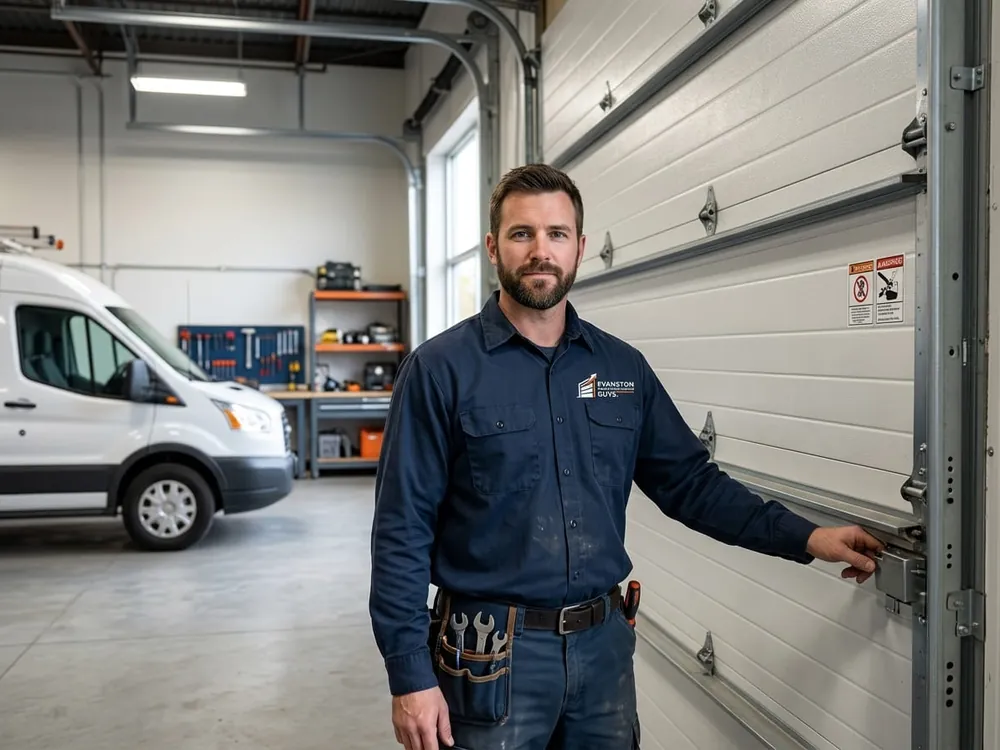
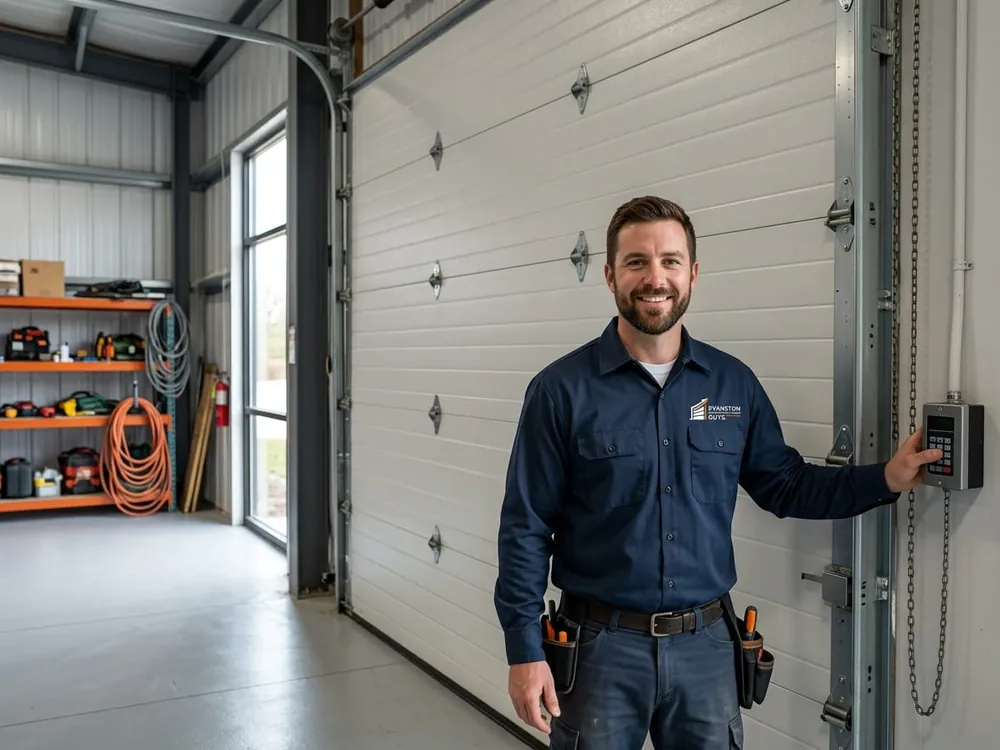
Nate came out of residential installation. Chris came out of ten years of commercial overhead doors, parking-deck sectionals and gate operators, and that is the side of the shop this page describes. They are related trades, not the same one.
The difference is that a house door is a convenience and a commercial door is a piece of plant. When a condo deck door stops halfway, forty residents cannot get to work and somebody is standing in the entrance in the dark making sure nobody gets hit. When a loading bay door jams, the trucks stack up. So the questions change: not just what broke, but how often does this thing move, what does an hour of it being shut cost you, and is the hardware on it specified for the duty it is actually doing.
Geographically we work a tight radius from the shop on Brown Ave. That covers the mid-rise decks in downtown Evanston, the lakefront condo buildings south of Howard St in Rogers Park and Edgewater, the industrial belt out toward McCormick Blvd and Hartrey Ave, and the storefront strips on Howard Street, the Main-Dempster Mile and Central Street. Small enough that we are not sending a van forty minutes to a callout, which is most of what makes a response time real. More about how the shop is set up on the about page.
03 What we get called to
Five door types and a gate, each failing in its own particular way.
Downtown mid-rises and the lakefront buildings in Edgewater and Rogers Park. Huge cycle counts, resident fobs, loop detectors, and a door that has to stay closed for security between cars.
The west-side industrial belt near McCormick Blvd and Hartrey Ave. Impact damage from forklifts and trailers, bent bottom sections, and track that gets clipped often enough to need proper realignment rather than a bend-back.
Read moreHoward Street, the Main-Dempster Mile and Central Street storefronts. Different animal entirely: a curtain of interlocking slats on a sprung barrel, with guides, a bottom bar and no sections or hinges.
Slide and swing gates at deck entries and yards. Safety edges, photo-eyes, loop detectors and reversing devices matter more here than anywhere, because the thing moves horizontally through a space people walk in.
Longer springs, heavier wire, larger drums, sized to the cycles the door genuinely does. It is the single decision that separates a deck door that lasts from one that eats springs twice a year.
Read moreTrolley, hoist and jackshaft units with duty ratings that suit continuous use, three-button stations, and control wiring that will pass an inspection. Not a residential head on a bigger door.
04 The number that matters
Ask how long a spring lasts and you will get an answer in years, which is meaningless. Springs are rated in cycles — one open and one close — and the only figure that predicts anything is how many of those your door does in a day.
Do the arithmetic once and it stops being abstract. A single-family attached garage runs three or four cycles a day, so a standard 10,000-cycle spring gives roughly seven years. A forty-unit condo deck door runs sixty. Sixty a day is 21,900 a year. That same 10,000-cycle spring is finished in under six months, and it will fail on a Sunday in February with a resident’s car half through the opening.
Spec a 100,000-cycle package on the same door and you are looking at four to five years instead. It costs more on the invoice and dramatically less per year, and it does not put a board through an emergency vote. That is the whole argument, and it is why the first thing we ask a property manager is not what broke but how many cars use this door on a weekday.
Owners inherit these. Somebody replaced a failed deck operator with a hardware-store unit because it fitted the bracket and cost a fifth as much. Twelve months later it is dead. No mystery in it.
A residential opener head is built around a plastic drive gear and a motor rated for a handful of starts a day, with a thermal cut-out sized for that pattern. Run it sixty times daily and the motor never fully cools, the gear wears through, and the travel and force settings drift until somebody turns the force up to compensate — which is the point where the reversing system stops protecting anyone. Commercial operators use metal gearing, continuous-duty or high-duty motors, and control gear designed to be interrupted constantly. We follow the published DASMA operator guidance on which class belongs on which door, and we will tell you when a job genuinely does not need the bigger unit. Repairing what is there is often the cheaper move — see opener repair.
05 Duty and specification
Count cars, not calendars. Count the trips through that door on an average weekday and read across.
| Door and use | Cycles per day | Cycles per year | What it needs | What fails first if underspecified |
|---|---|---|---|---|
| Single-family attached garage | 3–5 | About 1,500 | Standard 10,000-cycle springs | Very little — this is what the parts were designed for |
| Two-flat or shared coach house | 8–12 | About 3,600 | 25,000-cycle springs, nylon rollers | Cables and drums, then the opener gear |
| Small condo deck, 12–20 units | 25–35 | About 11,000 | 50,000-cycle springs, light commercial operator | The residential opener, within a year or two |
| Large condo deck, 40+ units | 60–80 | 22,000–29,000 | 100,000-cycle package, commercial operator, heavy track | Springs in months, opener in weeks |
| Loading bay, one active shift | 30–50 | About 10,000 on weekdays | 100,000-cycle package, industrial operator, impact-tolerant bottom section | Bottom section and track from strikes |
| Retail rolling shutter | 2 | About 700 | Barrel spring service interval, guide and slat maintenance | Seized barrel, worn guides, bent bottom bar |
Not sure of your number? Count the fobs issued, or watch the door for an hour at 8am. Ring (224) 505-2236 with the figure and we can talk specification before anyone measures anything.
06 Planned maintenance
Intervals get set to duty, not to the calendar. A retail shutter that moves twice a day is an annual visit. A forty-unit deck door doing 22,000 cycles a year is quarterly, and we would rather tell you that than sell you four visits you do not need.
We work to the published DASMA door and hardware guidance on inspection and hardware selection, and we tell you which items are urgent and which can wait a quarter.
07 How it runs
Most of our commercial work is repeat work for the same handful of buildings, which only happens if the admin side is easy.
Door by door: type, size, duty, spring package fitted, operator class, safety devices, condition. You end up with a list you can actually budget from instead of a series of surprises.
Not one blanket contract. The deck door and the bin store door do not need the same attention, and pretending they do is how buildings overpay and still get failures.
Ring (224) 505-2236 and describe the door by the name on the survey. We know what is fitted, what we last did to it and what was already flagged, so the diagnosis starts before we arrive.
Condition, what was done, what is coming and roughly when. Association boards turn over and budgets get set once a year — a note that makes sense in November is worth more than a technical printout.
Out-of-hours deck work is often sensible in an occupied building — closing the only vehicle entrance at 8am is nobody’s idea of a good morning. Say so when you book and we schedule around residents.
08 Worth asking about
If your building has a rolling steel door or shutter in a fire-rated wall — common between a parking deck and a stair core, between a loading area and a warehouse, or across a service counter — that assembly is not just a door. It is part of the fire separation, held open by a release device and designed to close on its own when heat or an alarm triggers it.
Those assemblies are generally required to be drop-tested annually and reset, with a written record kept, under the standard the fire code adopts for the maintenance of fire door assemblies. It is the sort of requirement that quietly lapses when a building changes managing agents, and it tends to resurface during an inspection or an insurance review at the worst possible moment.
We are raising it because most people we meet do not know whether it has ever been done on their building. Two things worth doing this month: find out whether any of your doors are fire-rated — there is usually a metal label on the guide or the hood — and ask whoever maintains them for the last drop test record. If nobody can produce one, that is your answer.
Confirm the current requirements for your specific building with the City and your fire prevention bureau rather than taking a contractor’s word for it, including ours; codes and adopted editions change. The City of Evanston is the starting point for a building inside the city limits, and buildings in Rogers Park and Edgewater fall under the City of Chicago instead.
Routine service on the door itself — curtain, guides, barrel, bottom bar, operator, and the mechanical release hardware — is ordinary work for us, and so is everything on the non-rated doors in the same building. Where a job needs somebody with a specific accreditation we do not hold, we will tell you that plainly and say who to ring. That is a shorter conversation than discovering it halfway through.
For anything that has already failed, emergency repair and off-track work on commercial doors follow the same rules as residential: stop using it, keep people clear, and ring. Hours are on the contact page.
06 Questions we get asked
What boards, managing agents and business owners ask us most.
One call reaches the people who will actually be doing the work. Tell us what the door is doing and we will tell you straight what it needs — and when we can get a truck to you.