
Queen Anne and Italianate
Ornate, vertical, 1860–1900. A flat modern panel door kills it. Go to a recessed long-panel or a carriage-house overlay with restrained hardware, in a colour taken off the trim rather than the siding.
01 Repair & installation
Replacing a door that had years left in it is a waste of money, and repairing one that is finished is a worse one. We will show you which side of that line your door sits on before anyone talks about panels.
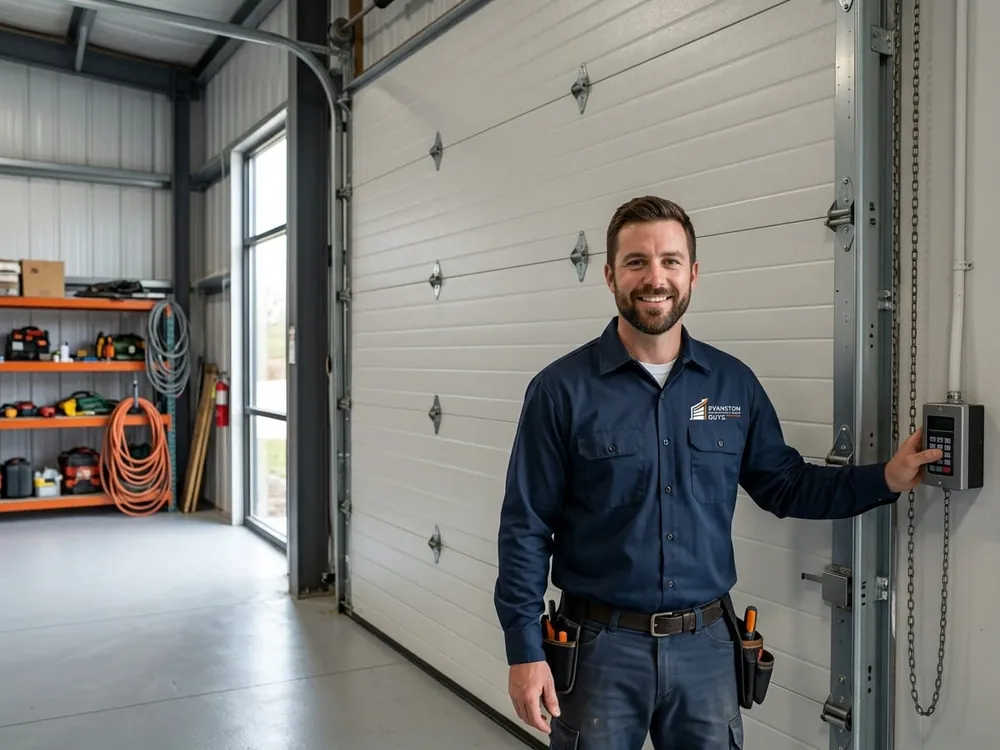
02 The honest arithmetic
Every garage door replacement in Evanston starts with the same question, and the honest answer is often "not yet". Here is how we work through it on site, in front of you, before anything is quoted.
| Situation | What we usually recommend | Why |
|---|---|---|
| A spring, cable or roller has failed on a sound door under about fifteen years old | Repair | These are wear parts. The door is fine and has years left. |
| One section dented, panels for that door line still available | Repair | A section swap costs a fraction of a door and matches. |
| Opener has died but the door balances by hand | Repair the opener only | Separate systems, separate decisions. Do not buy a door. |
| Wood door with a rotted bottom rail, sound elsewhere | Repair, usually | A rebuilt bottom rail on a period door beats a modern replacement. |
| Three or more different failures in two years | Replace | You are buying the door in instalments, at a service call each time. |
| Springs, cables and rollers all due at once on an old single-skin door | Discuss both | The repair gets you most of the way to a new door's cost. |
| Panels delaminating, hinge screws no longer biting into the stiles | Replace | There is nothing sound left for new hardware to hold. |
| Door so far out of square that no track adjustment holds it | Replace, after checking the slab and header | The door is not the only problem, and a new one alone will not fix it. |
The genuinely honest bit: plenty of doors sit in the middle, and the answer then depends on how long you plan to stay in the house. We give you both numbers. You decide.
03 The four signals
You can check most of this yourself in five minutes with the opener disconnected. If two or more of these are true, a replacement conversation is reasonable. If none are, be suspicious of anyone selling you one.
None of these true, but the door is just noisy or slow? That is nearly always rollers or a balance and hardware problem, and it is a cheap afternoon rather than a new door.

04 What you get
People buy doors for curb appeal and then find the other four things matter more day to day.
Rigidity. A modern sectional with proper struts across the top section does not flex when the opener grabs it. That single change stops the racking that chews rollers and pulls hinges out of old panels.
Weather sealing. New perimeter stop moulding, a fresh bottom astragal set to your actual floor line, and vinyl between the sections. On a garage backing an unpaved alley where water ponds after heavy rain — and the whole city is on a combined sewer system designed to hold water at street level rather than in your basement — that seal is doing real work.
Quiet. Nylon rollers, tight hardware and an insulated door on a belt or wall-mount unit is a different experience, and it is the main reason people with a bedroom over the garage replace early.
Security. Modern bottom brackets, tamper-resistant lift fittings, and no gap at the bottom corner big enough to get a bar into.
05 Match the house
Evanston is not one architectural era, and the wrong door reads wrong from thirty feet away. The City's own survey of the Lakeshore Historic District counted 91 Queen Annes and 48 Italianates among its nineteenth-century houses, then 100 Colonial Revivals, 83 Craftsman and bungalow homes and 47 Tudor Revivals from the twentieth.
Ornate, vertical, 1860–1900. A flat modern panel door kills it. Go to a recessed long-panel or a carriage-house overlay with restrained hardware, in a colour taken off the trim rather than the siding.
The Oakton blocks and much of the 1920s stock. Short recessed panels, a row of square lights across the top section, and a stained or deep matte finish. This is the easiest era to get right.
Half-timbering wants vertical emphasis and dark hardware. A carriage-house overlay with strap hinges reads correctly; a horizontal ribbed steel door does not.
The 1950s blocks out toward the West End and southwest Evanston, median build year around 1952. Long horizontal panels, flush or lightly ribbed, minimal hardware. Restraint is the whole style.
Insulated steel, raised or flush panel, often a double. Here the decision is R-value, gauge and opener choice rather than aesthetics — and insulation genuinely pays because the garage is attached.
Evanston legalised accessory dwelling units in 2020 and permits garage and above-garage conversions. That changes the brief entirely: insulated door, quiet drive, sealing that suits a conditioned space next door.
06 The practical questions
With us. The springs are de-tensioned before anything is dismantled, then the sections, track and hardware come out and the steel goes for recycling. Nothing gets left stacked in the alley — worth saying, because the City grades more than 300 unpaved alleys each spring and a pile of panels is exactly what a grader has to steer around. If the old door is a period wood one you want to keep for a workshop wall, say so and we will set it aside instead.
Often it does. Two things decide it. Condition first: a unit with a worn trolley, a chewed drive gear or a failing logic board will not improve because the door in front of it is new. Then weight — if you are moving from a single-skin steel door to an insulated one, you have added real mass, and an opener already near its limit will strip its gear inside a couple of years. We will tell you which of those you are dealing with. If it does need doing, the opener page covers what suits a low-headroom garage, and if it is repairable we would rather repair it.
Your door is built to your opening. Nothing about a garage door is off the shelf except the very plainest steel in the very commonest sizes. Overlays, custom widths, unusual colours, glazing and anything wood all add weeks, and spring is the busiest ordering season on the North Shore. We give you a realistic window when you order and tell you if it moves. If the current door is unusable in the meantime, a holding repair keeps the garage working rather than leaving you without one for a month.
If your property is a local landmark or sits inside one of Evanston's local landmark districts, permitted exterior work that can be seen from a public way needs a Certificate of Appropriateness — and the City counts an alley as a public way. Ask the City's preservation staff what applies to your address before you choose a style, and confirm the current requirement rather than trusting any page. It is a phone call. Changing your mind on paper is free.
07 The day itself
A single door is usually a morning. A double, or anything with jamb repair or a low-headroom conversion, is a day.
Springs de-tensioned first, then sections, track, brackets and old hardware removed back to bare jambs, and the old door loaded.
Rot cut out of jambs, header checked where the spring anchor lands, floor line measured across the full opening so the bottom seal has something real to sit on.
Vertical track plumbed, sections stacked and hinged, horizontal track levelled, then new springs wound to a count calculated from the finished door's weight — not the old door's.
Hand-balance check with the opener off, force and travel limits reset, both photo-eyes tested against an obstruction, and you cycle the door yourself before we go.
New door, old springs is a false economy we will not do. A door that has changed weight needs springs sized to the new weight, or you are back to a broken spring inside two years.
08 Local conditions
Two Evanston-specific things shorten a door's working life, and both are worth factoring into the replace-or-repair decision.
Water at the threshold. The entire city is served by a combined sewer system, most of it eighty to a hundred years old, with flow restrictors deliberately designed so heavy rain backs up at street level rather than into basements. Add hundreds of ungraded gravel alleys and standing water at a garage door is a normal event here, not a disaster. It rots wood bottom rails, rusts bottom brackets and swells panels from the bottom up.
Road salt, not lake salt. Lake Michigan is fresh water, so corrosion here has nothing to do with the lake. What it has everything to do with is 3,377 tons of granular salt and 52,616 gallons of brine spread across 190 miles of city road in a single winter, arriving home on tyres into an unheated detached garage. Bottom brackets, hinges, track and spring wire all take it.
Neither is a reason to replace a sound door. Both are reasons that a door bought in 1998 for a garage off an unpaved alley in west Evanston is genuinely older than its years, while the same door on an attached garage in a Glenview subdivision may still be fine. Judge the door in front of you, not the date on the paperwork.
We survey replacements across Evanston and out to Skokie, Wilmette and Winnetka from the shop on Brown Ave. Note that some North Shore villages regulate door width — the width rules are worth reading before you settle on a design. Call (224) 505-2236 for a survey, or read who turns up.
06 Questions we get asked
The questions that decide whether you spend the money.
One call reaches the people who will actually be doing the work. Tell us what the door is doing and we will tell you straight what it needs — and when we can get a truck to you.