
Stripped drive gear
The plastic worm gear inside the motor head shears its teeth. Motor runs with a grinding whirr, nothing moves. A gear kit and an hour fixes it — and it is very often a dying spring that caused it.
01 Component repairs
Most openers we are called to have not failed. The ones that have are usually repairable for a fraction of a new unit — a gear kit, a trolley, a capacitor, a board. We check which of those it is before quoting anything.
02 What actually breaks
In rough order of how often we find them. Note that the most common cause of an opener call is not on this list at all, because it is not the opener.
The plastic worm gear inside the motor head shears its teeth. Motor runs with a grinding whirr, nothing moves. A gear kit and an hour fixes it — and it is very often a dying spring that caused it.
The part that rides the rail and grabs the door arm. When the release mechanism wears or the inner sleeve splits, the door disconnects itself mid-travel or refuses to re-engage after you pull the red cord.
Lights flash a code, or the unit ignores one input and answers another. Surge damage is common — an unheated detached garage on an old branch circuit is not a gentle electrical environment.
The motor hums but will not start, or starts only if you help the door. A cheap part and a short job, and frequently the difference between a repair and an unnecessary new opener.
The door closes a foot and reverses, or will not close unless you hold the wall button. Misalignment, a cobweb, a knocked bracket — or low winter sun straight down the alley into the receiving eye.
The remote works and the wall button does not, or the reverse. Usually a broken low-voltage staple run, a corroded terminal, or contacts that have given up after twenty years of thumbs.
03 The expensive mistake
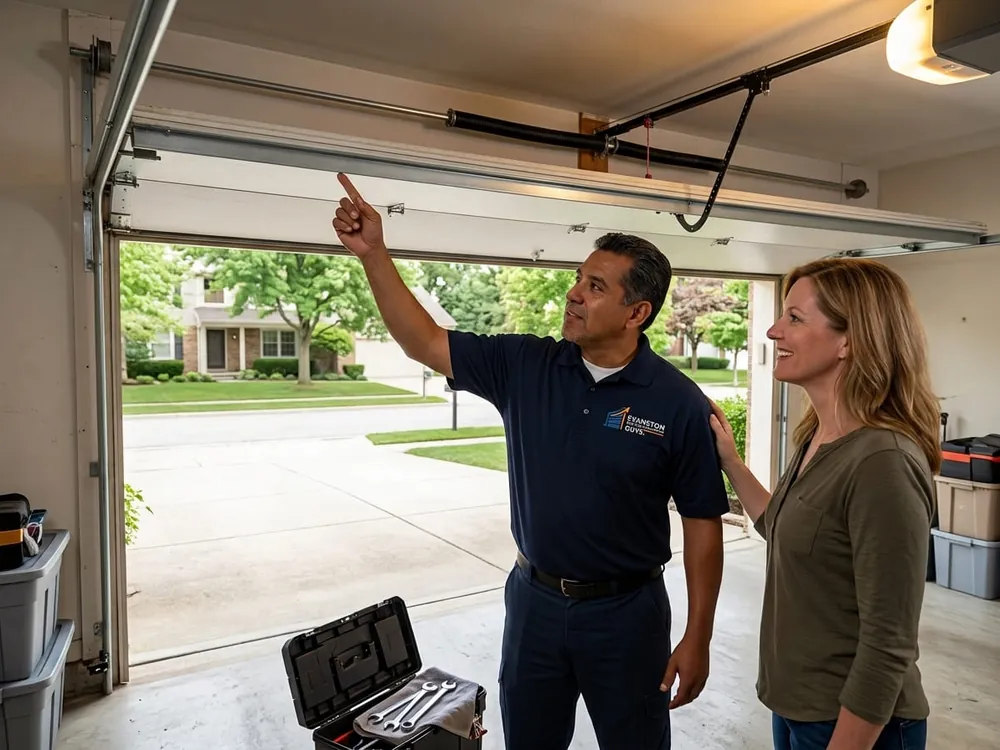
This is the single most common misdiagnosis in the trade, and it costs Evanston homeowners real money every winter. The opener runs. The door does not move. Everyone concludes the opener is dead. It usually is not.
Your door weighs between roughly 130 and 400 pounds. The opener does not lift that and was never designed to — the springs do, and the opener is a positioning motor guiding an already-balanced door along a track. When a spring breaks, the opener is asked to deadlift the whole door through a chain and a plastic gear. It stalls, strips the gear, or lifts six inches and reverses. All three look exactly like a dead opener.
Look up at the steel shaft above the opening while you are there. A clean one-inch gap in the coil answers the question outright. If you find one, stop, leave the door down, and call (224) 505-2236 — every additional attempt with the opener risks a bent top section on top of everything else.
04 Symptom triage
What we run through mentally when you describe the fault on the phone. It narrows most calls to two possibilities before we load the van.
| What you are seeing | Usual cause | Typical fix |
|---|---|---|
| Motor runs, grinding noise, door still | Stripped drive gear — or a broken spring that caused it | Gear kit, after checking the door balances by hand |
| Motor hums but will not start | Capacitor, or a seized motor | Capacitor replacement is the first thing to try |
| Door reverses about a foot after touching the floor | Close force or down-limit set wrong, or a bind in the track | Reset the limits and find the bind — never raise the force |
| Door reverses immediately on closing, sensor light blinking | Photo-eyes misaligned, obstructed, or sun-blinded | Realign, clean, re-bracket, and shade the receiving eye if needed |
| Trolley disconnects mid-travel | Worn trolley or a failed release mechanism | Trolley replacement |
| Wall button works, remotes do not | Lost programming, dead remote battery, or a failing receiver | Reprogram; replace receiver or board if it will not hold |
| Remotes work, wall button does not | Broken low-voltage run or a failed wall control | Trace and repair the wiring, or replace the control |
| Unit lights flash a pattern and nothing happens | Logic board fault or a sensor circuit fault | Diagnose the code, then board or sensor replacement |
| Works fine in summer, poorly below freezing | Dry or thickened lubricant, or a door binding on a frozen seal | Service the rail and free the bottom seal — see the door, not just the head |
Not on the list? Call (224) 505-2236 and describe it. Fifteen years of these means we can usually narrow it down before we arrive. If the door itself is misbehaving rather than the motor, start with general repair.
05 The trap
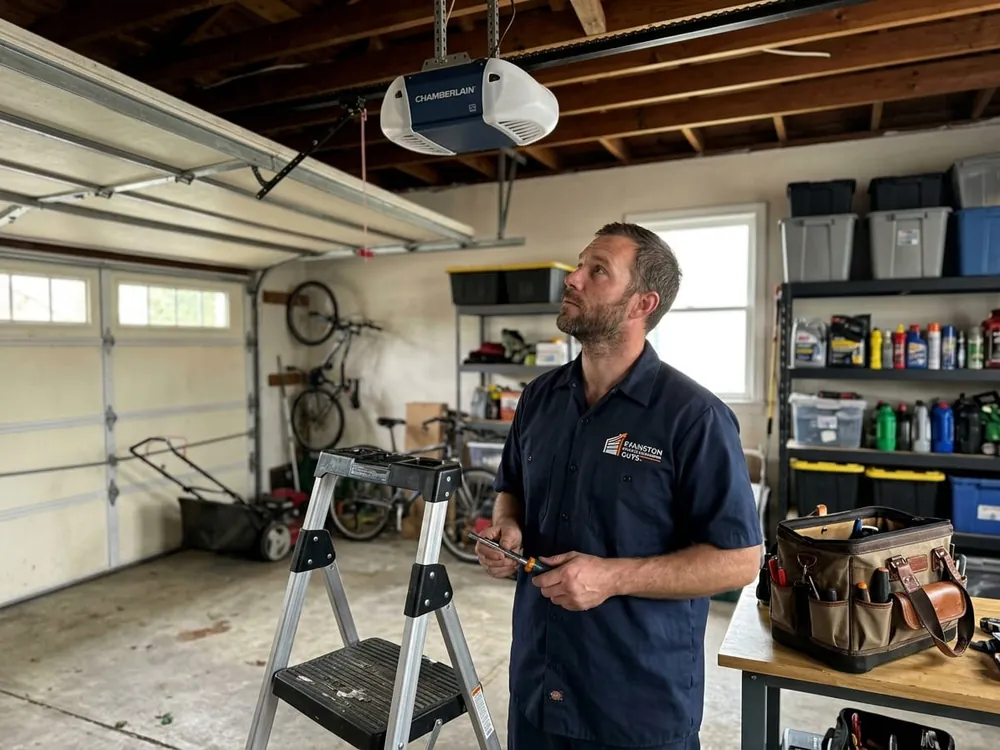
Here is the sequence we find in perhaps one garage in five. A door starts binding — a dry roller, a track pushed out of plumb by a settled slab, a spring losing tension. The opener senses resistance and reverses, because that is exactly what it is built to do. Someone finds the force adjustment and turns it up until the door stops reversing.
The bind is still there. The door is still fighting. What has changed is that the safety system which was protecting a child, a pet or your own hand has been dialled out of the way. An opener with the down-force wound up will keep pushing a closing door into whatever is underneath it.
Force settings are a diagnostic reading, not a volume knob. If a door needs more force this year than last, something mechanical changed, and that is the thing to fix. DASMA's guidance on opener operation is clear about it, and so is the CPSC on entrapment protection. We set force to the minimum that moves the door reliably, then test the photo-eyes and the mechanical reversal against an obstruction — every visit.
06 The visit
Opener disconnected, door hand-balanced. If the door is not balanced, nothing we do to the motor head will hold, and we would be selling you a repair that fails.
Gear condition, trolley wear, chain or belt tension, capacitor, board behaviour, and the sensor circuit read at the terminals rather than guessed from a blinking light.
A gear kit, trolley, capacitor or board is usually a fraction of a new unit. If parts are scarce, or the unit cannot be made to reverse safely, we say so plainly.
Force and travel limits set to the door as it now behaves, both photo-eyes aligned and tested, remotes and keypad reprogrammed, and you cycle it yourself before we leave.
If the unit does need replacing, the installation page covers what suits a low-headroom detached garage — which in this housing stock is most of them.
07 Repair or replace
We repair far more openers than we replace, and that is not charity — a gear kit is an hour and a part. The line falls roughly here.
We also check the mechanical reversal and both photo-eyes on every visit regardless of what you called about, following DASMA's system safety guidance. It takes two minutes and it is the part of the job that actually matters.
08 Drive types and local conditions
The NOAA normals show 121 days a year with a low at or below freezing, a January average high of 31.6°F against a low of 18.8°F, and six and a half days at or below zero. The motor head in a detached garage lives in all of it. Lubricant thickens, plastic goes brittle, and a bottom seal frozen to the slab makes the first lift of the day several times heavier than normal. That frozen lift strips gears. If your unit only misbehaves in cold weather, service it before you condemn it — the climate numbers explain more faults here than any manufacturer defect.
Two more local specifics. Low winter sun down an east–west alley can flood a photo-eye receiver and make a perfectly aligned sensor read as blocked, which is why we re-bracket and shade rather than just realign. And road salt — 3,377 tons of granular plus 52,616 gallons of brine across 190 miles of Evanston road in one winter — gets into the terminals of sensor brackets mounted six inches off the slab, which is where the intermittent faults come from.
If the door is the problem, we fix the door rather than the motor — springs, cables, rollers or track, depending on what we find, and usually for less than the opener you were about to buy. If everything is tired at once, replacement is a conversation with real numbers on both sides.
We cover Evanston and the near North Shore from Brown Ave — south Evanston, downtown, Skokie and Lincolnwood are short runs. If your car is shut in behind a dead opener, say so when you call (224) 505-2236. See hours and how to reach us, or our buying guide for old garages.
06 Questions we get asked
What people ask before they spend money on a new unit they may not need.
One call reaches the people who will actually be doing the work. Tell us what the door is doing and we will tell you straight what it needs — and when we can get a truck to you.